


ION BLUE GHK-Cu Copper Peptide Serum
ION BLUE GHK-Cu Copper Peptide Serum
The honest copper peptide serum. GHK-Cu (copper tripeptide-1) is one of the most-studied peptides in skincare — and one of the most over-marketed. We do it differently: a single peptide, at a real, disclosed 0.10% pure GHK-Cu (1,000 ppm), with nothing hidden inside a “proprietary blend.” Fragrance-free, with every ingredient listed.
Why not 1%? Because a bigger number isn’t a better one. Some “1%” figures describe a diluted supplier solution or a peptide blend, not pure GHK-Cu. What a copper peptide “%” really means →
With consistent use over several weeks, GHK-Cu is studied to support the appearance of firmer, smoother, healthier-looking skin. We’re honest about it: changes are gradual and appearance-level, not overnight — and every claim links to real, published research. The truth wins.
What’s in it
- Copper Tripeptide-1 (GHK-Cu) — 0.10% pure (1,000 ppm). The one peptide, disclosed on the bottle and here. No blends, no fillers, no diluted trade solution counted as if it were pure.
- Sodium Hyaluronate (500 kDa) — 0.50% for hydration.
- Propanediol — 3.00% as the carrier.
- Water as the base, and a gentle phenoxyethanol / ethylhexylglycerin preservative system to keep it stable and safe.
- Full table with every amount: Ingredients & Transparency
Specs
| Active | Copper Tripeptide-1 (GHK-Cu) |
|---|---|
| Concentration | 0.10% w/w pure GHK-Cu (1,000 ppm), not a blend or diluted solution |
| Supporting | Sodium hyaluronate 0.50% (500 kDa); propanediol 3.00% |
| Fragrance | None |
| Size | 30 mL |
| Use | Topical cosmetic. Not for injection. |
| Lot verification | Third-party assay in progress; results will be published when complete |
Why 0.10% and not a bigger number
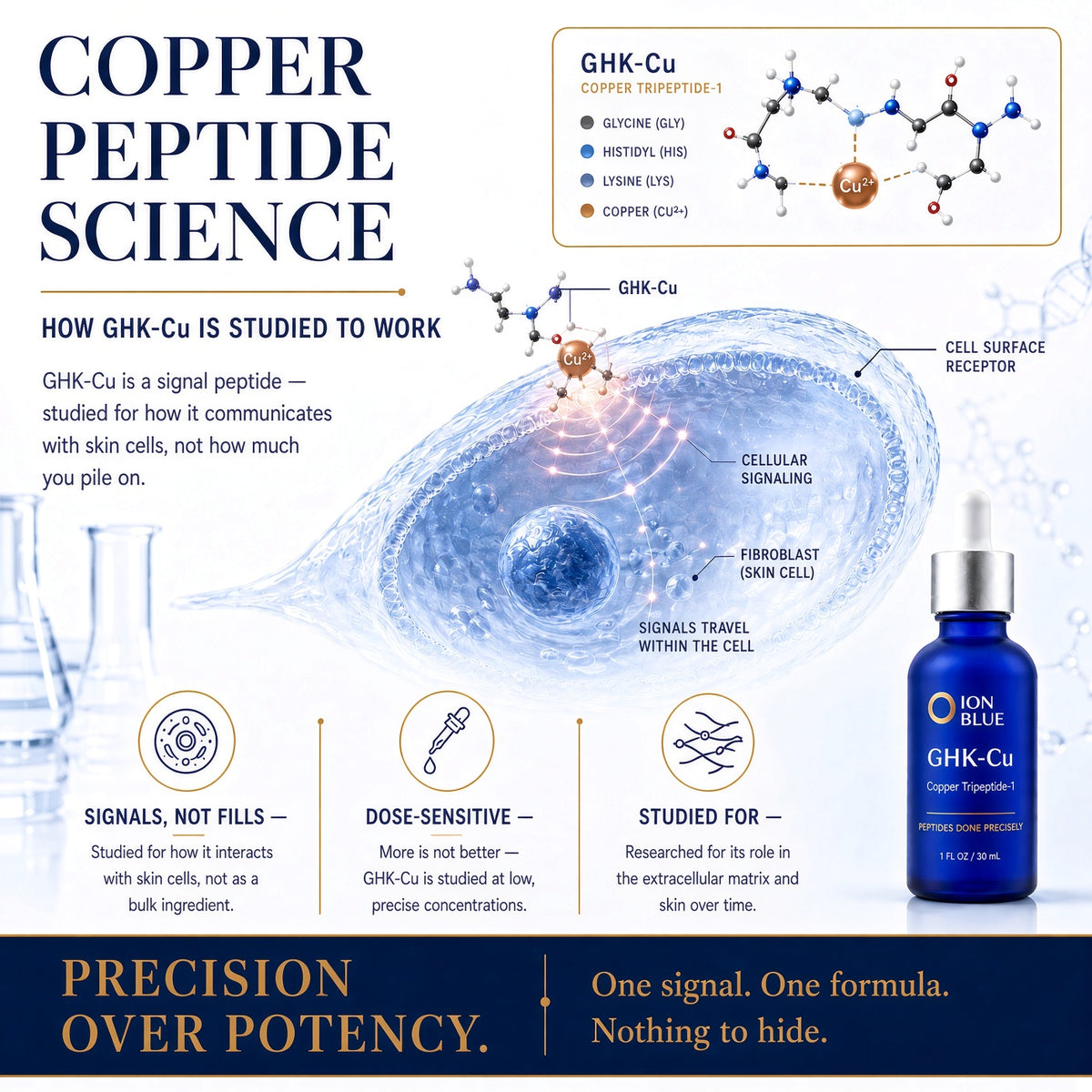
GHK-Cu is a signaling peptide that’s studied to be active at very low concentrations, and copper is potent both ways — more isn’t better. We chose a conservative, research-informed dose and printed it. Read the full reasoning →
How to use
A few drops on clean, slightly damp skin, once or twice daily, followed by moisturizer (and sunscreen in the morning). Patch-test first; give it weeks to months. If you use vitamin C or retinol, apply those at the other end of the day. Full routine →
What to pair it with
| Use with | How |
|---|---|
| Hyaluronic acid, niacinamide, moisturizer, SPF | Same routine |
| Retinol or tretinoin | Opposite time of day (guide) |
| Vitamin C (L-ascorbic acid) | Opposite time of day (guide) |
| AHAs, BHAs, azelaic acid | Separate nights (full chart) |
The research, linked
- Do copper peptides actually work? — the honest evidence review
- What is GHK-Cu? — the complete guide
- Copper peptide side effects and safety — what’s reported, cited
- Topical vs injectable GHK-Cu — why they’re not the same
- Scientific references — every study we cite, with full citations
- The ION BLUE Standard — the rules we hold ourselves to
ION BLUE products are cosmetics and are not intended to diagnose, treat, cure, or prevent any disease. Topical use only. Not for injection. Individual results may vary.
Why 0.10% (and not 1%)?
Why 0.10% (and not 1%)?
GHK-Cu is studied at low concentrations, and copper is a potent, redox-active metal — more isn't automatically better. What matters isn't the biggest number on the label; it's knowing the real one. We disclose ours at 0.10% so you can judge it for yourself.
Why not 1%? Some “1%” figures describe a diluted supplier solution or a peptide blend, not pure GHK-Cu. Ours is 0.10% pure GHK-Cu (1,000 ppm): the peptide itself. What a copper peptide “%” really means.
How to use
How to use
Apply a few drops to clean skin, morning or night, before your moisturizer (and sunscreen in the morning). Using vitamin C or retinol? Use them at the opposite time of day. Gentle enough for daily use — if your skin is sensitive, start every other day.
What's inside
What's inside
One peptide, fully disclosed: pure copper tripeptide-1 (GHK-Cu) 0.10% (1,000 ppm). Plus sodium hyaluronate (500 kDa) 0.50% for hydration, propanediol 3.00% as the carrier, water, and a gentle phenoxyethanol/ethylhexylglycerin preservative. Fragrance-free. No fillers, no proprietary blends. Full table: Ingredients & Transparency.
The science, honestly
The science, honestly
Every level of evidence, graded — tap a study to read it yourself.
- Human skin cells: GHK-Cu raised MMP-2 together with its inhibitors TIMP-1 and TIMP-2 in dermal fibroblast cultures (matrix remodeling). Siméon et al., Life Sciences, 2000. Read
- Animal: more connective tissue and collagen in healing rat wounds. Maquart et al., J Clin Invest, 1993. Read
- Human, wound healing: controlled trial of topical GHK-Cu on diabetic ulcers. Mulder et al., Wound Repair Regen, 1994. Read
- Human, cosmetic: small controlled studies (8–12 weeks) reporting fewer visible fine lines and firmer-looking skin, summarized by Pickart & Margolina, Int J Mol Sci, 2018. Read Note: Pickart is the molecule's principal researcher and his company sells copper peptides.
What's missing: large, independent, long-term cosmetic trials. So we say “studied for,” not “proven to.” All sources: References.
FAQ
FAQ
Is 0.10% actually a lot? It depends on what you compare it to, so here's both sides. Ingredient suppliers list roughly 0.05%–1% as the usage range for copper tripeptide-1, which puts 0.10% toward the lower end of that range, by choice. Compared with how peptides are commonly used in cosmetics, it's a meaningful amount: an industry submission to the Cosmetic Ingredient Review panel reported cosmetic peptides are typically used at 1–30 ppm, with under 10 ppm customary. 0.10% is 1,000 ppm. And because GHK-Cu is a signaling peptide studied at very low concentrations, a bigger number isn't automatically better. What matters is that you know the real one.
What about serums that say “1% copper peptides”? That figure often describes a supplier solution or a multi-peptide complex, not pure GHK-Cu, so the actual GHK-Cu can be far lower. If a label doesn't state the GHK-Cu percentage itself, you can't tell. More: what a copper peptide “%” really means.
Use it with retinol or vitamin C? Use them at different times of day.
How long until results? Gradually — weeks to months of consistent use, with subtle, appearance-level changes.
Side effects? Generally well tolerated; patch-test and introduce gradually.
Sources: Cosmetic Ingredient Review Expert Panel, Safety Assessment of Tripeptide-1, Hexapeptide-12, Their Metal Salts and Fatty Acyl Derivatives, and Palmitoyl Tetrapeptide-7 as Used in Cosmetics, International Journal of Toxicology, 2018 (doi:10.1177/1091581818807863); SpecialChem, Copper Tripeptide-1 ingredient profile.



The truth is our active ingredient.
0.10% pure GHK-Cu. 0.50% hyaluronic acid. 3.00% propanediol. Every claim cited. The truth wins.