
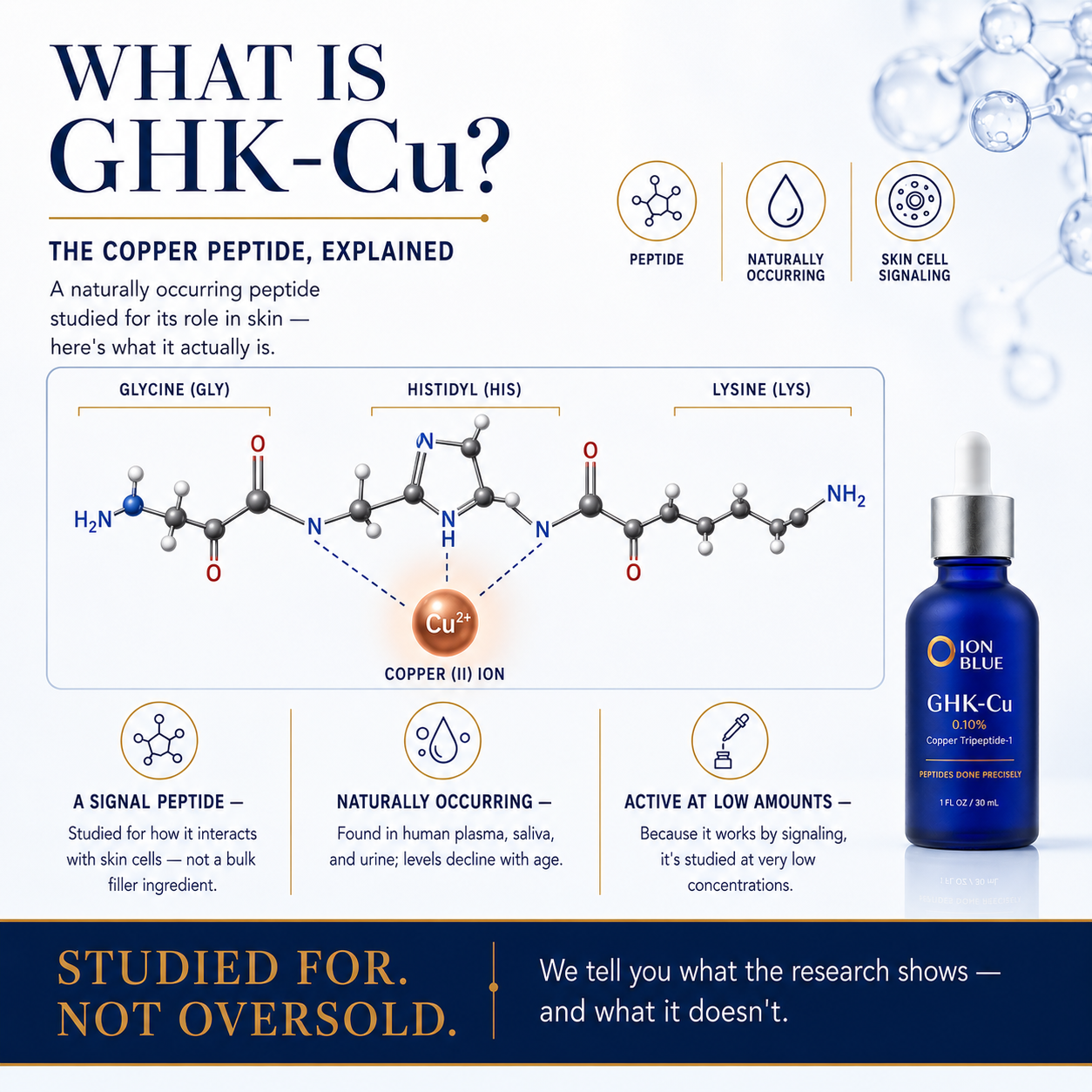
What Is GHK-Cu? The Complete, Honest Guide to the Copper Peptide
GHK-Cu is one of the most studied — and most over-marketed — molecules in skincare. It shows up on labels as “copper peptide,” “copper tripeptide-1,” or tucked anonymously inside a “proprietary blend.” It’s surrounded by both real peer-reviewed research and a lot of breathless marketing that runs well past what that research actually says.
This guide is the honest version. What GHK-Cu is, how it’s studied to work, what the evidence genuinely supports, where that evidence is still thin, and how to read a copper peptide label without getting sold a story. No hype — just what’s known, what isn’t, and the sources so you can check us.
The short answer
GHK-Cu is a copper-binding tripeptide — three amino acids (glycine, L-histidine, and L-lysine) bound to a single copper ion. Its full chemical name is glycyl-L-histidyl-L-lysine-copper, and on ingredient lists it’s usually written as copper tripeptide-1.
It isn’t synthetic in origin. GHK occurs naturally in human blood plasma, where it circulates at meaningful levels when we’re young and declines substantially with age — from roughly 200 ng/mL around age 20 to about 80 ng/mL by age 60, in the figures Pickart’s reviews report.1 That age-related decline is a big part of why researchers became interested in it: the idea that replenishing a molecule the body makes less of over time might support skin’s repair machinery.
Where GHK-Cu came from
GHK was first isolated in the 1970s by Dr. Loren Pickart, who observed that a factor in young human plasma could make aged liver tissue behave more like young tissue. That factor turned out to be the GHK tripeptide, and it binds copper with high affinity — hence GHK-Cu.1,3 Much of the foundational research on the molecule traces back to Pickart and colleagues, which is worth knowing for context: a large share of the literature comes from the peptide’s original proponents. That doesn’t make the findings wrong, but it’s the kind of thing an honest guide tells you so you can weigh it yourself.
How GHK-Cu is studied to work
The interesting thing about GHK-Cu is that its studied activity happens at tiny concentrations. In laboratory work, GHK-Cu at 1–10 nanomolar — a very low, nontoxic level — stimulated both the synthesis and the breakdown of collagen and glycosaminoglycans, the structural molecules of the dermis.2 That “synthesis and breakdown” phrasing matters: it points to remodeling — turning over old matrix and building new — rather than simply piling on more collagen.
From the peer-reviewed record, the mechanisms that have actually been studied include:
Extracellular matrix support. GHK-Cu has been shown to stimulate collagen along with dermatan sulfate, chondroitin sulfate, and the small proteoglycan decorin — several of the components that give skin its structure and resilience.2 Explore what these are in our glossary: the extracellular matrix, collagen signaling, and fibroblasts, the cells that produce them.
Fibroblast vitality. In one line of research, GHK-Cu restored replicative vitality to fibroblasts taken from patients after anticancer radiation therapy — cells that were otherwise impaired.2
Modulating remodeling enzymes. GHK has been shown to modulate the activity of matrix metalloproteinases and their inhibitors (TIMP-1 and TIMP-2) — the enzyme system that governs how skin tissue is broken down and rebuilt.2
Wound healing. This is the strongest and oldest part of the evidence base. In animal studies, GHK-Cu accelerated wound healing and increased blood vessel formation and antioxidant enzyme levels in rabbits, and induced systemic wound healing in rats, mice, and pigs.2,3 Read more on wound healing and oxidative stress.
Anti-inflammatory and antioxidant signaling. Copper complexes including GHK have been shown to reduce TNF-alpha–induced secretion of the pro-inflammatory cytokine IL-6, among other antioxidant and anti-inflammatory actions described in the reviews.2
A 2018 review went further and looked at GHK’s effects on gene expression, reporting that the peptide appears to influence a broad range of human genes — generally in the direction of resetting tissue toward a healthier, more regenerative state.1 That’s a genuinely interesting finding, and also exactly the kind of result that marketing loves to inflate. Gene-expression changes in a model system are not the same as a proven cosmetic outcome on your face.
What the research shows on human skin — and what it doesn’t
Here’s where honesty earns its keep.
What there is: Beyond the lab and animal work, there are small, placebo-controlled human studies in which GHK-Cu creams “improved skin laxity, clarity, and appearance, reduced fine lines and the depth of wrinkles, and increased skin density and thickness,” and stimulated keratinocyte proliferation.2 So the human cosmetic evidence is not zero — it exists, and it’s positive.
What there isn’t: Those human studies are generally small, older, and often connected to the molecule’s proponents. Large, independent, long-term clinical trials — the kind that would let anyone claim a specific concentration produces a specific result over months of everyday use — remain limited. The deepest, most rigorous evidence for GHK-Cu is still in the wound-healing and laboratory domains, not in big cosmetic trials.
So the honest summary is this: GHK-Cu is a real, well-characterized molecule with a plausible, studied mechanism and encouraging early human data — not a proven wrinkle cure. Anyone selling it as the latter is ahead of the evidence. We’d rather stay level with it.
Why concentration is the question nobody answers
Because GHK-Cu’s studied activity happens at very low concentrations, “more” is not automatically “better.” Copper is a redox-active metal: useful at the right level, potentially a source of oxidative stress if pushed too high. A responsible copper peptide formula respects that, rather than treating a big number on the label as a selling point.
The catch is that most brands won’t even tell you their number. Because GHK-Cu is so often buried inside a proprietary blend, you frequently can’t tell whether a serum contains a functional amount or a marketing trace. That’s the gap ION BLUE was built to close — we disclose ours at a real 0.10%, and we explain the reasoning in depth on Why 0.10%?
How to read a copper peptide label
A quick, honest checklist you can use on any product, ours included:
- Does it disclose the GHK-Cu concentration as a real number? If it only says “copper peptides” or “proprietary blend,” you can’t judge it.
- Is GHK-Cu a named active, or one drop in a crowded blend? More ingredients isn’t more efficacy; it’s often less of each.
- Do the claims match the evidence? “Supports skin’s structure” is defensible. “Erases wrinkles in a week” is not.
- Are sources cited? A brand that links primary research is one you can check. One that doesn’t is asking for trust it hasn’t shown.
How to use GHK-Cu (in brief)
GHK-Cu serums are typically applied to clean skin and layered under moisturizer. A few honest notes: introduce any new active gradually and patch-test first; give a signaling peptide realistic time (think months, not days); and be aware that some strong actives and certain forms of direct vitamin C are commonly discussed as things to separate from copper peptides in a routine — the interaction question is nuanced, so pair thoughtfully rather than assuming. We cover routine specifics in our how-to guide (link once published).
Frequently asked questions
What is GHK-Cu?
A copper-binding tripeptide (glycyl-L-histidyl-L-lysine plus copper), listed as copper tripeptide-1. It occurs naturally in human plasma and declines with age.1
Does GHK-Cu actually work?
It has a real, studied mechanism — supporting the extracellular matrix, modulating remodeling enzymes, and aiding wound healing in lab and animal research — plus small placebo-controlled human studies showing improvements in fine lines, skin density, and appearance.2 Large independent long-term cosmetic trials are still limited, so it’s best described as evidence-backed and promising, not clinically proven to transform skin.
Is GHK-Cu the same as “copper peptides”?
GHK-Cu is the most studied copper peptide, but “copper peptides” is a broader category. Always check which peptide, and at what concentration.
What concentration of GHK-Cu should a serum have?
Its biological activity is studied at very low concentrations, and copper’s potency means more isn’t automatically better.2 What matters most is that the brand discloses the number so you can judge it. We use and disclose 0.10% — see Why 0.10%?
Are there side effects?
GHK-Cu is generally well tolerated in the studies to date, but any active can cause irritation for some people. Patch-test, introduce gradually, and consult a professional if you have a specific concern.
Where can I read the research myself?
Every claim on this page links to primary literature, and we keep a full list on our Scientific References page. The truth wins — so we hand you the sources.
References
- Pickart L, Margolina A. Regenerative and Protective Actions of the GHK-Cu Peptide in the Light of the New Gene Data. International Journal of Molecular Sciences. 2018;19(7):1987. PMID: 29986520. pubmed.ncbi.nlm.nih.gov/29986520
- Pickart L, Vasquez-Soltero JM, Margolina A. GHK Peptide as a Natural Modulator of Multiple Cellular Pathways in Skin Regeneration. BioMed Research International. 2015;2015:648108. DOI: 10.1155/2015/648108. pmc.ncbi.nlm.nih.gov/articles/PMC4508379
- Pickart L. The human tri-peptide GHK and tissue remodeling. Journal of Biomaterials Science, Polymer Edition. 2008;19(8):969–988. PMID: 18644225. pubmed.ncbi.nlm.nih.gov/18644225