
Why 0.10% GHK-Cu? The Honest Concentration Answer
Ask most skincare brands how much GHK-Cu is in their copper peptide serum and you'll get a shrug dressed up as a secret. "Proprietary blend." "Clinical strength." "Advanced complex." What you almost never get is a number.
We'll give you ours up front: 0.10% GHK-Cu (copper tripeptide-1). Disclosed on the bottle, disclosed here, and the same in every batch. This page explains why that number — and why we think the number itself matters less than the fact that we're willing to print it.
The industry's quiet blind spot
Concentration is the single most important thing about an active ingredient, and it's the thing the skincare industry is least willing to talk about. A serum can say "with copper peptides" on the front and contain a trace so small it rounds to nothing. Because "GHK-Cu" often sits inside a proprietary blend, the label is technically true and practically meaningless. You can't compare two products, you can't judge value, and you can't tell whether you're buying an active or a marketing story.
That's the gap ION BLUE was built to close. Not by claiming the highest number — by disclosing the real one.
First, what GHK-Cu actually is
GHK-Cu is a copper-binding tripeptide (glycyl-L-histidyl-L-lysine bound to copper) that occurs naturally in human plasma and declines with age. It's been studied for decades for its role in skin biology — cellular signaling, the extracellular matrix, and wound repair. If you want the full picture of the evidence, including where it's strong and where it's still thin, read What Is GHK-Cu? and our Scientific References. This page is specifically about the dose.
Why more isn't automatically better
The intuition that a bigger percentage means a better product breaks down with a molecule like GHK-Cu, for a few reasons.
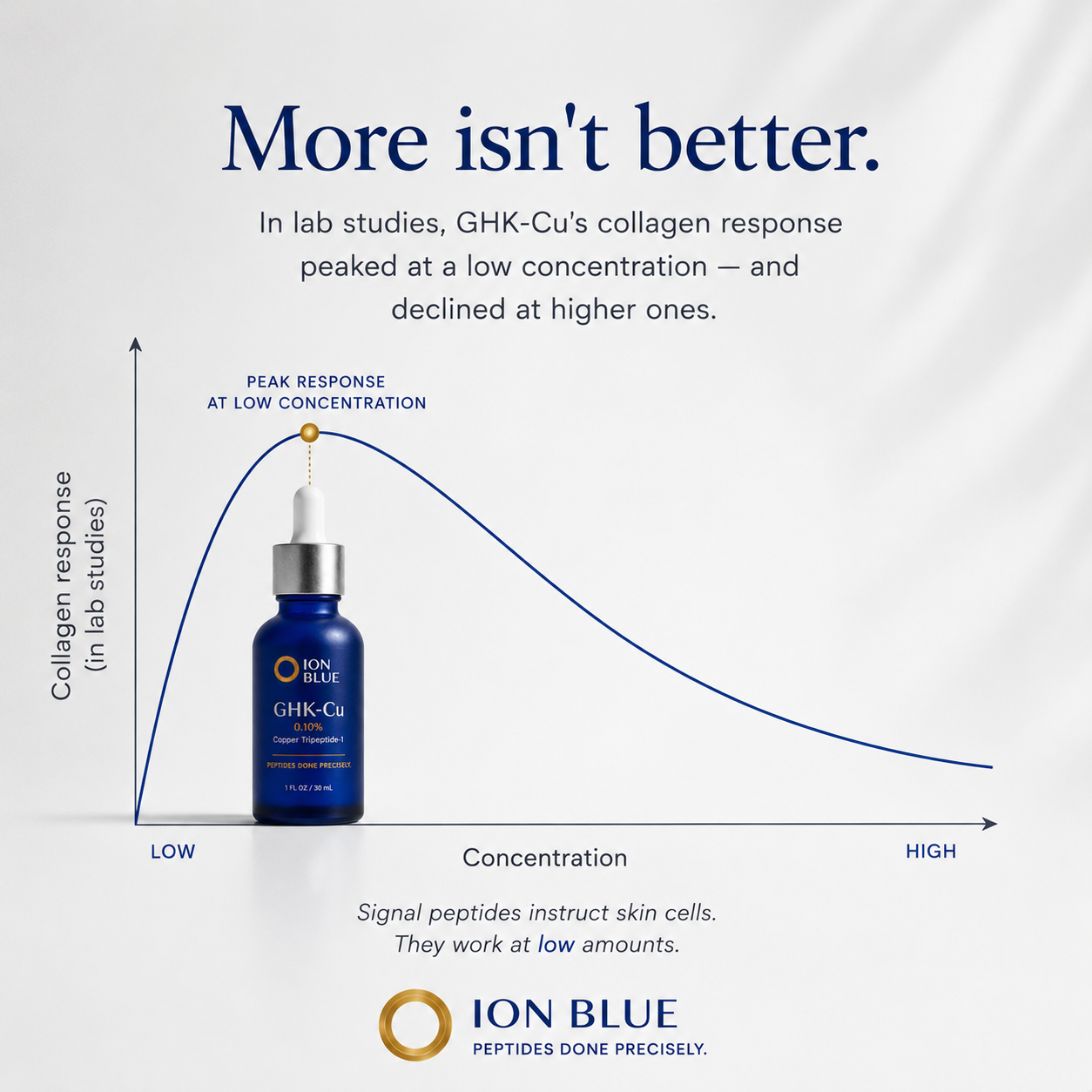
It's bioactive at low concentrations. GHK-Cu is a signaling peptide, not a bulk exfoliant or a humectant you slather on. In laboratory research, its activity on skin's structural molecules has been observed at just 1–10 nanomolar — a very low, nontoxic level, where GHK-Cu stimulated both the synthesis and breakdown of collagen and glycosaminoglycans.1 Signaling molecules like this work by fitting a lock, not by flooding the room. (One honest caveat: a nanomolar concentration in a lab dish is not the same unit as a topical percentage on skin — we cite this to show the molecule is potent at low levels, not to claim 0.10% equals that figure.)
Copper is potent, and potency cuts both ways. The "Cu" in GHK-Cu is copper, a redox-active metal. At the right level it participates in useful enzymatic processes; pushed too high, copper can contribute to oxidative stress rather than relieve it. A responsible copper peptide formula respects that ceiling instead of treating "more" as a selling point.
Higher concentrations trade off tolerability and formulation stability. Loading a serum with more peptide can raise irritation risk and complicate keeping the molecule stable and bioavailable. A number that looks impressive on a label isn't the same as a number that behaves well on skin.
None of this means "lowest wins" either. It means there's a considered range, and the honest move is to pick a defensible point inside it and tell you what it is.
What the research does — and doesn't — support
Here's where we stay in our lane, because the honest version of this story has edges.
The strongest and oldest evidence for GHK-Cu comes from wound-healing and tissue-repair research — it accelerated wound healing and raised antioxidant enzyme levels in animal studies — alongside a large body of laboratory work on collagen, the extracellular matrix, and gene expression.213 There are also small, placebo-controlled human studies in which GHK-Cu creams improved skin laxity, reduced the depth of fine lines and wrinkles, and increased skin density.1 That's genuinely encouraging. What's thinner is large, independent, long-term clinical trials on topical cosmetic GHK-Cu at a specific percentage in everyday use. That body of evidence is still developing.
So we won't tell you 0.10% is a clinically proven miracle, because that claim would outrun the data. What we'll tell you is that 0.10% is a research-informed, deliberately conservative, fully disclosed concentration — chosen to sit in the studied, well-tolerated range for a signaling peptide rather than to win a spec-sheet contest.
Why we landed on 0.10% — and printed it
Three principles drove the number:
Stay in the evidence-supported, well-tolerated range for a copper signaling peptide, rather than chasing a high number for marketing.
Formulate for a single, honest active — no blend to hide behind, so the concentration has to stand on its own and be defensible.
Disclose it, permanently. A number you can verify is worth more than a bigger number you can't.
That last point is the whole brand. The percentage is a choice reasonable formulators could debate at the margins — 0.10% versus some other figure in the studied range. What isn't debatable is whether you deserve to know the figure. You do.
What we don't claim
We don't claim 0.10% outperforms every other concentration — the independent head-to-head data to settle that doesn't exist yet, and we won't pretend it does. We don't claim GHK-Cu replaces a dermatologist, sunscreen, or a retinoid. And we don't claim overnight results. We claim exactly one thing without hedging: the number on our bottle is real, and it's the number we told you.
FAQ
Is 0.1% GHK-Cu effective? GHK-Cu is a signaling peptide studied at low concentrations, so 0.10% sits within the range the research tradition works in rather than being a "trace." The most robust evidence is in wound-healing and lab research; topical cosmetic trials at a fixed percentage are still emerging. We chose 0.10% as a conservative, disclosed dose and we're honest about the limits of the evidence.
Why don't you use 1% or 2% like some serums? Some products cite higher figures, but "more" isn't automatically better for a redox-active copper peptide — higher levels can raise oxidative and tolerability concerns without a proven benefit. We'd rather sit in the studied range and disclose it than compete on a bigger number.
How much GHK-Cu is in most serums? Often unstated — it's the industry's quiet blind spot. Because GHK-Cu is frequently tucked inside a "proprietary blend," most labels don't let you know. That's exactly why we disclose ours.
Will you ever change the concentration? If the evidence base changes what "well-formulated" means, we'll follow the evidence — and we'll tell you if we do. Transparency includes telling you when something changes.
References
All three verified against PubMed/PMC, July 2026 — links resolve to primary literature.
Internal links to add: What Is GHK-Cu? · The Science · Scientific References · Shop the 0.10% serum
Footnotes
Pickart L, Vasquez-Soltero JM, Margolina A. GHK Peptide as a Natural Modulator of Multiple Cellular Pathways in Skin Regeneration. BioMed Research International. 2015;2015:648108. DOI: 10.1155/2015/648108. https://pmc.ncbi.nlm.nih.gov/articles/PMC4508379/ ↩ ↩2 ↩3
Pickart L, Margolina A. Regenerative and Protective Actions of the GHK-Cu Peptide in the Light of the New Gene Data. International Journal of Molecular Sciences. 2018;19(7):1987. PMID: 29986520. https://pubmed.ncbi.nlm.nih.gov/29986520/ ↩
Pickart L. The human tri-peptide GHK and tissue remodeling. Journal of Biomaterials Science, Polymer Edition. 2008;19(8):969–988. PMID: 18644225. https://pubmed.ncbi.nlm.nih.gov/18644225/ ↩