
Wound Healing and the Skin: What the Research Shows
Read this first: This page explains wound-healing biology for education. ION BLUE products are cosmetics — they are not intended to treat, heal, or manage wounds or any medical condition. If you have a wound, see a qualified medical professional.
The short version: wound healing is one of the body's most impressive coordinated processes — and it happens to be the area where the copper peptide GHK-Cu has its strongest, oldest research. Understanding the biology explains why scientists got interested in GHK-Cu in the first place. It does not mean a face serum heals wounds — and we'll be crystal clear about that line throughout.
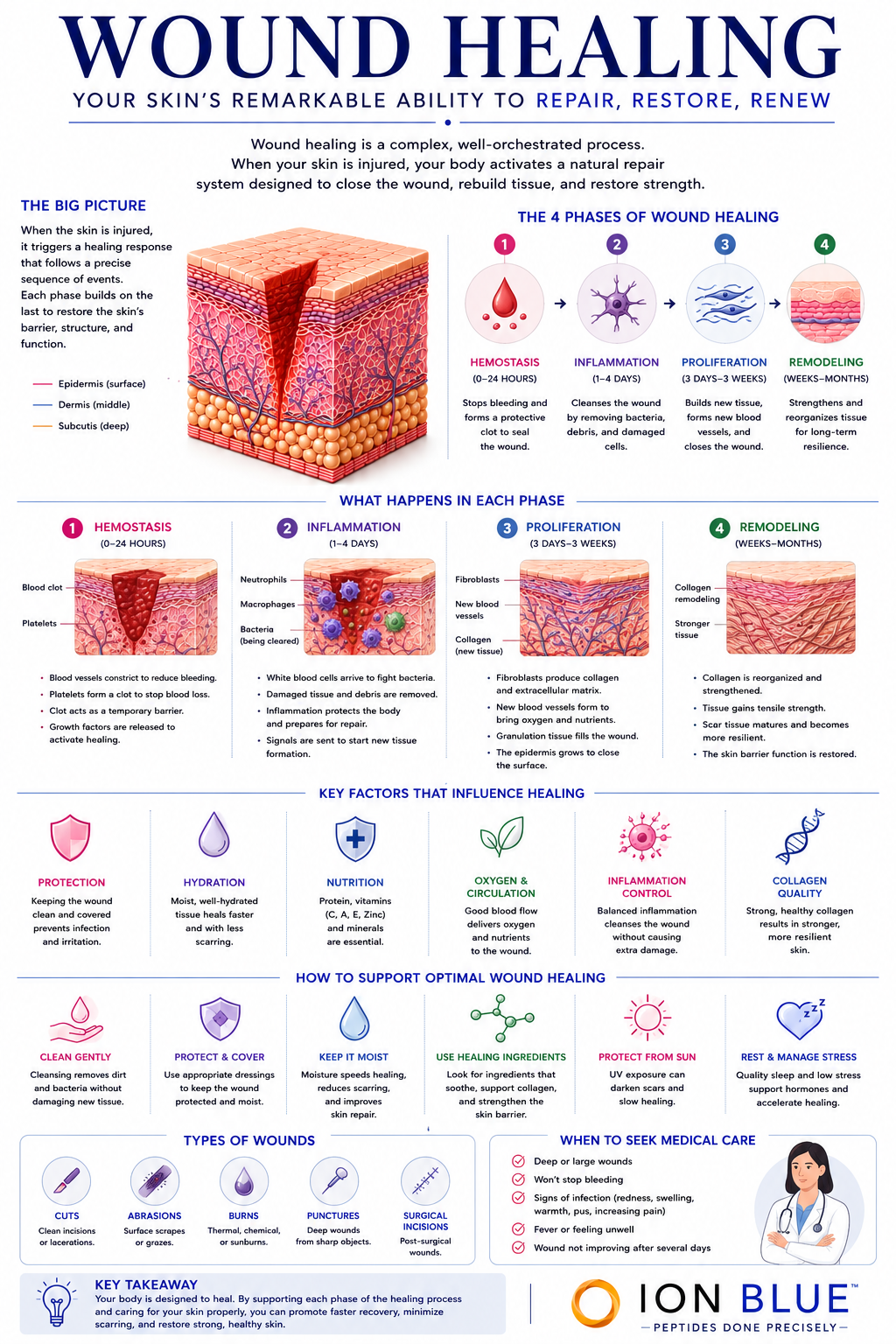
How the skin heals: the four phases
When skin is injured, repair unfolds in overlapping stages:
- Hemostasis — bleeding stops and a clot forms to seal the wound.
- Inflammation — immune cells clean the site and defend against infection.
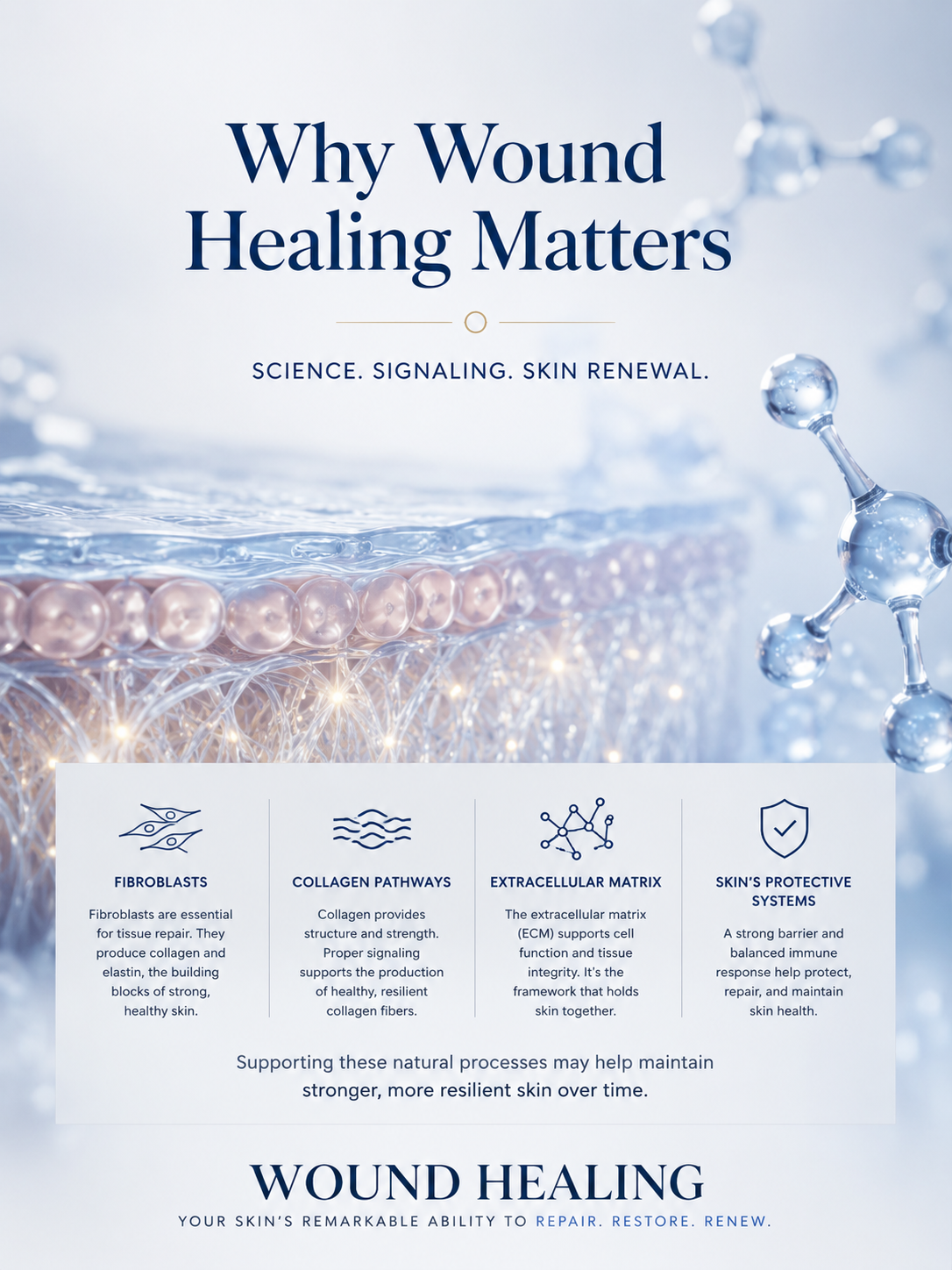
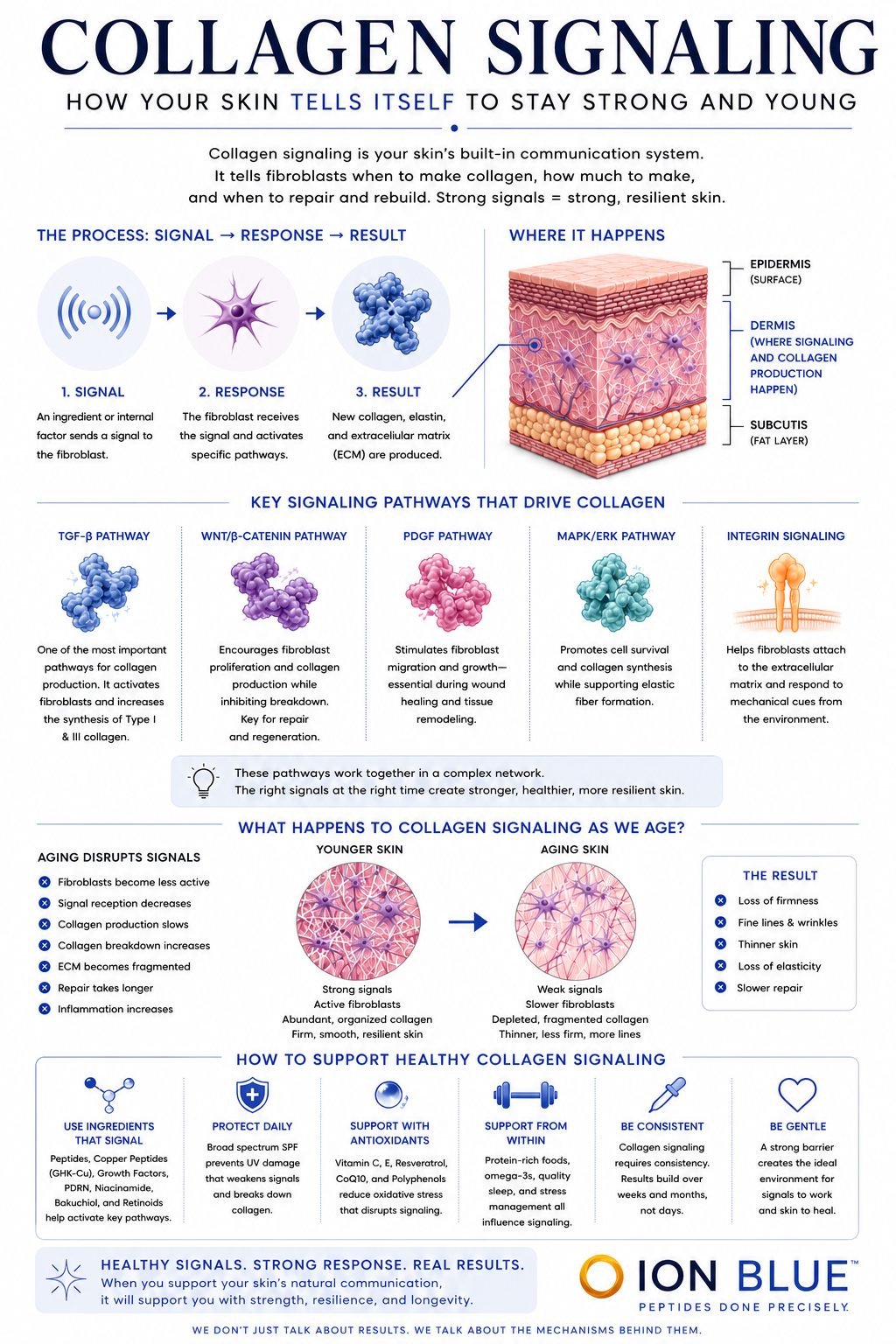
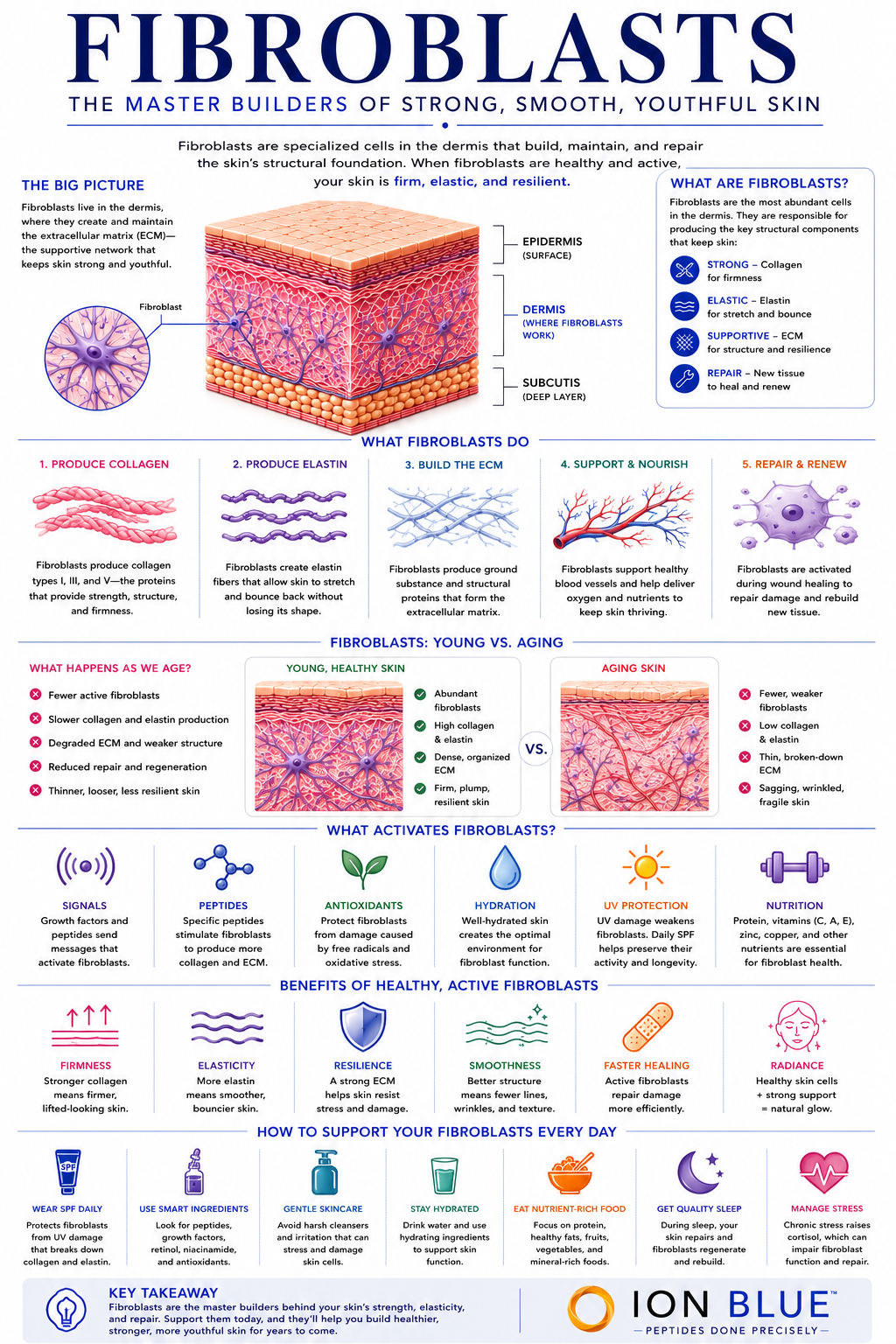
- Proliferation — new tissue is built: fibroblasts lay down fresh collagen and extracellular matrix, and new blood vessels form to supply it.
- Remodeling — over weeks to months, the new tissue is reorganized and strengthened.
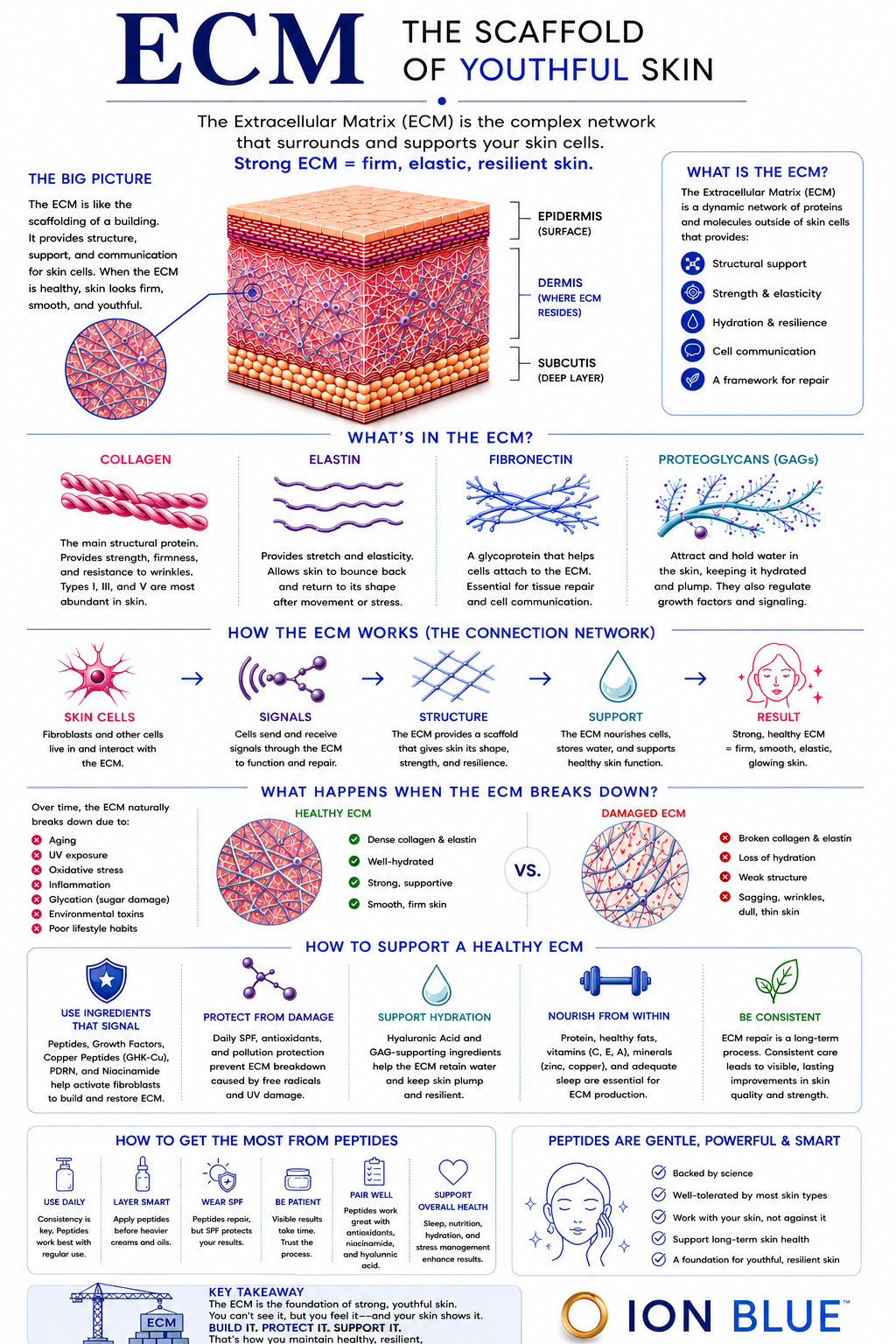
Notice how much this overlaps with everyday skin maintenance: the same cells, matrix, and signals that repair a wound are the ones that keep skin structured day to day. That overlap is exactly why wound-healing science is so relevant to skin biology in general.
Why wound-healing research matters for understanding GHK-Cu
GHK-Cu wasn't discovered as a cosmetic ingredient — it was studied for its role in tissue repair. That's where its deepest evidence base sits, and it's why the molecule is taken seriously. In laboratory and animal research, GHK-Cu has been shown to accelerate wound healing and increase blood vessel formation and antioxidant enzyme levels, and to support systemic wound healing across several animal models.1,2 It has also been studied for helping modulate the tissue-remodeling process itself.2
This research is genuinely interesting, and it's the honest reason a copper peptide is worth studying for skin. It's also, importantly, research conducted in laboratory, animal, and clinical wound contexts — not evidence that a cosmetic serum treats wounds.
The line we don't cross
Here's the boundary, stated plainly: describing what GHK-Cu has done in wound-healing research is science. Claiming that an ION BLUE cosmetic heals wounds would be a medical claim we are not making and that would not be true of a cosmetic. Those are two different statements, and we keep them separate on purpose. If you're dealing with an actual wound, a burn, or a skin condition, that's a matter for a healthcare professional — not a serum.
Where ION BLUE fits
We find the wound-healing research fascinating because it's why GHK-Cu exists as a subject of study at all. But our product is a cosmetic: a topical GHK-Cu serum at a disclosed 0.10%, formulated to support the appearance of healthy skin. We link the underlying research so you can read it in context on our Scientific References page, and we explain the honest efficacy picture in Do Copper Peptides Actually Work? Start with What Is GHK-Cu? for the primer.
Frequently asked questions
What are the stages of wound healing?
Hemostasis (clotting), inflammation (cleaning and defense), proliferation (building new tissue), and remodeling (reorganizing and strengthening it over time).
Is GHK-Cu proven to heal wounds?
GHK-Cu has a strong body of laboratory and animal wound-healing research, which is the oldest and deepest part of its evidence base. That research is about the molecule in medical and lab contexts. It is not a claim about any cosmetic product, and a cosmetic serum is not a wound treatment.
Can I use ION BLUE on a wound?
No. ION BLUE is a cosmetic for the appearance of healthy skin, not intended to treat, heal, or manage wounds or any medical condition. For a wound, see a qualified medical professional.
Educational content is not medical advice. ION BLUE products are cosmetics and are not intended to treat, heal, or manage wounds, or to diagnose, treat, cure, or prevent any disease. Individual results may vary.
References
- Pickart L, Vasquez-Soltero JM, Margolina A. GHK Peptide as a Natural Modulator of Multiple Cellular Pathways in Skin Regeneration. BioMed Research International. 2015;2015:648108. Read the full paper →
- Pickart L. The Human Tri-Peptide GHK and Tissue Remodeling. Journal of Biomaterials Science, Polymer Edition. 2008;19(8):969–988. Read on PubMed →
Continue Exploring Skin Biology
Download the Wound Healing PDF
"This page explains wound-healing biology for education. ION BLUE products are cosmetics — they are not intended to treat, heal, or manage wounds or any medical condition."