
What a Copper Peptide "%" Really Means (And Why It's Usually Not What You Think)
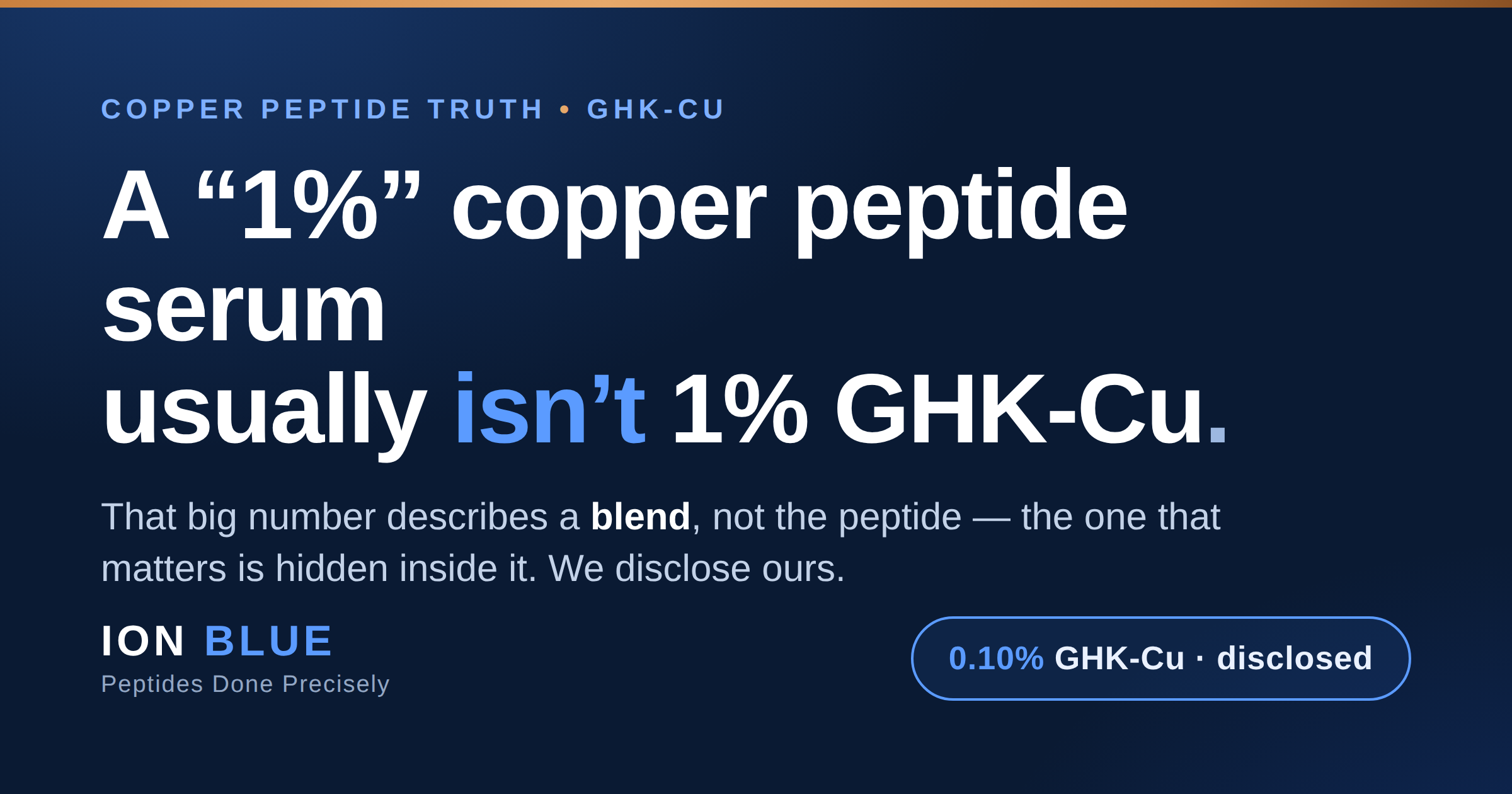
The short version: when a copper peptide serum advertises a big percentage — "1%," "5%," a "top-rated" or "#1" formula — that number almost always describes a blend, not the amount of GHK-Cu. Which means you usually can't tell how much GHK-Cu you're actually getting, or whether it's dosed sensibly. ION BLUE takes the opposite approach: one active, one disclosed number, and the research to back it. Here's how to read a label so no one can sell you a number that doesn't mean what you think.
The percentage on the label is not the GHK-Cu amount
This is the single most important thing to understand. Many of the best-selling copper peptide serums list a headline percentage that refers to a multi-peptide complex — a mix of several different peptides. GHK-Cu might be just one of them. So a "1%" peptide serum can contain a fraction of a fraction of actual GHK-Cu, and the label will never tell you how much. The impressive number on the front isn't measuring the thing you came for.
Proprietary blends hide the one number that matters
When GHK-Cu sits inside a "proprietary blend" or "peptide complex," the brand isn't required to disclose how much of it is present. The result is a label that's technically accurate and practically useless: you can't compare two products, you can't judge value, and you can't tell whether you're buying a functional dose of copper peptide or a marketing sprinkle. That's not a small footnote — it's the whole ballgame, hidden.
More isn't automatically better — copper is potent both ways
Even when a serum does state a higher copper peptide number, bigger isn't automatically better. The "Cu" in GHK-Cu is copper, a redox-active metal: at the right level it supports useful processes, but in excess it can actually contribute to oxidative stress rather than relieve it. GHK-Cu is also studied to be active at very low concentrations in the first place. So a race to the highest number isn't a race to the best result — it's just a bigger number. (We explain our own reasoning in Why 0.10%.)
Crowded blends raise fair questions a single active avoids
Here's a formulation point worth knowing. Copper peptides have well-known sensitivities — they're commonly advised to be kept separate from certain other actives (like direct vitamin C and strong acids) because of possible interactions. When a serum packs GHK-Cu into a crowded multi-active blend, it at least raises fair questions about compatibility and how much of each ingredient is really doing its job. A single-active formula simply sidesteps that whole question. We're not claiming every blend fails — we're saying a focused formula removes a variable you'd otherwise have to trust blindly.
What you're often really paying for
Put it together and the pricing gets interesting. You can pay a premium for a "top-selling" copper peptide serum and still have no idea how much GHK-Cu is inside, whether that amount is sensible, or whether it's competing with a half-dozen other actives in the bottle. A higher price and a bigger headline percentage can both be true while the one number that matters stays hidden.
The ION BLUE approach: one number, disclosed, backed by data
We built ION BLUE to be the opposite of all of that:
- One active. GHK-Cu — nothing else competing for space in the bottle.
- One disclosed number. A real, printed 0.10% — you always know exactly how much GHK-Cu you're getting.
- No blends, no fillers, no diluted formulations.
- Backed by evidence. We link the actual research behind every claim on our Scientific References page, and we describe the serum in terms of how skin looks — never with hype.
That's why we think ION BLUE is the clear choice for anyone who wants to actually know what they're putting on their face: not because we shout the biggest number, but because we tell you the real one and show our work. Start with What Is GHK-Cu?
How to read any copper peptide label (a 4-point filter)
- Does it disclose the GHK-Cu amount as a real number — not a blend percentage? If not, treat the GHK-Cu content as unknown.
- Is GHK-Cu a named, standalone active, or one of many peptides in a complex?
- Do the claims match the evidence, and are sources linked?
- Is the price buying you a known dose of copper peptide, or a mystery blend with a big number on the front?
Frequently asked questions
Does a "1%" copper peptide serum contain 1% GHK-Cu?
Usually not. That percentage typically describes a multi-peptide blend or complex, and GHK-Cu is only one part of it. The specific GHK-Cu amount is often undisclosed.
Is a higher copper peptide percentage better?
Not automatically. GHK-Cu is studied to be active at low concentrations, and copper is redox-active, so more can work against you. What matters most is knowing the actual amount.
How do I know how much GHK-Cu I'm getting?
Only if the brand discloses it as a specific number. If it's inside a proprietary blend, you can't — which is exactly why ION BLUE discloses ours at 0.10%.
This article discusses general practices in the copper peptide category and does not refer to any specific brand. Educational content is not medical advice. ION BLUE products are cosmetics and are not intended to diagnose, treat, cure, or prevent any disease. Individual results may vary.
References
- Pickart L, Vasquez-Soltero JM, Margolina A. GHK Peptide as a Natural Modulator of Multiple Cellular Pathways in Skin Regeneration. BioMed Research International. 2015;2015:648108. Read the full paper →